
Kia Stinger CK: What to do in an emergency
Contents:
- Road warning
- In case of an emergency while driving
- If the engine will not start
- Emergency starting
- If the engine overheats
- Tire Pressure Monitoring System (TPMS)
- If you have a flat tire
- Towing
Road warning
Hazard warning flasher
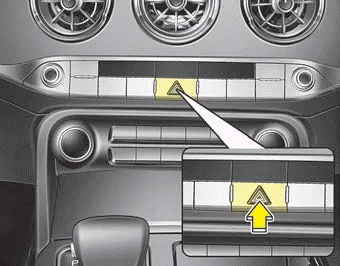
The hazard warning flasher serves as a warning to other drivers to exercise extreme caution when approaching, overtaking, or passing your vehicle.
It should be used whenever emergency repairs are being made or when the vehicle is stopped near the edge of a roadway.
Depress the flasher switch with the ignition switch in any position. The flasher switch is located in the center facia panel. All turn signal lights will flash simultaneously.
- The hazard warning flasher operates whether your vehicle is running or not.
- The turn signals do not work when the hazard flasher is on.
- Care must be taken when using the hazard warning flasher while the vehicle is being towed.
In case of an emergency while driving
If the engine stalls at a crossroad or crossing
If the engine stalls at a crossroad or crossing, set the shift lever in the N (Neutral) position and then push the vehicle to a safe place.
If you have a flat tire while driving
If a tire goes flat while you are driving:
1. Take your foot off the accelerator pedal and let the vehicle slow down while driving straight ahead. Do not apply the brakes immediately or attempt to pull off the road as this may cause a loss of control. When the vehicle has slowed to such a speed that it is safe to do so, brake carefully and pull off the road. Drive off the road as far as possible and park on firm level ground. If you are on a divided highway, do not park in the median area between the two traffic lanes.
2. When the vehicle is stopped, turn on your emergency hazard flashers, set the parking brake and put the transaxle in P.
3. Have all passengers get out of the vehicle. Be sure they all get out on the side of the vehicle that is away from traffic.
4. When changing a flat tire, follow the instruction provided later in this section.
If the engine stalls while driving
1. Reduce your speed gradually, keeping a straight line. Move cautiously off the road to a safe place.
2. Turn on your emergency flashers.
3. Try to start the engine again. If your vehicle will not start, contact an authorized Kia dealer or seek other qualified assistance.
✽ NOTICE
If there was a check engine light and loss of power or stall and if safe to do so, wait at least 10 seconds to restart the vehicle after it stalls. This may reset the car so it will no longer run at low power (limp home) condition.
If the engine will not start
If engine doesn't turn over or turns over slowly
1. Be sure the shift lever is in N (Neutral) or P (Park) and the emergency brake is set.
2. Check the battery connections to be sure they are clean and tight.
3. Turn on the interior light. If the light dims or goes out when you operate the starter, the battery is discharged.
4. Check the starter connections to be sure they are securely tightened.
5. Do not push or pull the vehicle to start it. See instructions for "Jump starting".
WARNING - Push/ pull start
Do not push or pull the vehicle to start it. Push or pull starting may cause the catalytic converter to overload and create a fire hazard.
If engine turns over normally but does not start
1. Check the fuel level.
2. With the Engine Start/Stop Button in the OFF position, check all connectors at the ignition coils and spark plugs. Reconnect any that may be disconnected or loose.
3. Check the fuel line in the engine compartment.
4. If the engine still does not start, call an authorized Kia dealer or seek other qualified assistance.
Emergency starting ➤
If the engine overheats ➤
Tire Pressure Monitoring System (TPMS) ➤
If you have a flat tire ➤
Towing ➤


Other information:
Kia Stinger (CK) 2018-2023 Owner's Manual: Steering Column & Shaft
Components and components location Components 1. Steering column module (SCM) 2. Steering column module (SCM) bracket Specifications Specification Item Specifications Rated Voltage DC 12 V Operating Voltage Range DC 9 - 16 V Operating Temperature Range -30°C ~ +75°C Storage Temperature Range -40°C ~ +85°C Dark Current Max.Kia Stinger (CK) 2018-2023 Owner's Manual: Variable Charge Motion Actuator (VCMA)
Components and components location Components ECM directly controls the actuator and the rotation of motor operates the VCM flap of intake manifold in link structure to create tumble in air. Mounted inside the actuator, the motor and position sensor sense the position of flap and send feedback to ECM to determine the current location of flap and detect abnormal operation due to adherence of foreign substance.Categories
- Manuals Home
- Kia Stinger Owners Manual
- Kia Stinger Service Manual
- Road warning
- In case of an emergency while driving
- If the engine will not start
- Emergency starting
- If the engine overheats
- Tire Pressure Monitoring System (TPMS)
- If you have a flat tire
- Towing
- New on site
- Most important about car
Contents
