
Kia Stinger CK: Maintenance / Chassis
Contents:
- Brake/Clutch Fluid
- Disc Brakes and Pads
- Drive Shafts and Boots
- Parking Brake
- Steering Gear Rack, Linkage and Boots
- Suspension Ball Joints
- Suspension Mounting Bolts
- Tire (pressure & tread wear)
Brake/Clutch Fluid
Repair procedures
| Inspection |
Check the brake fluid level in the brake fluid reservoir. The level should be between “MIN” and “MAX” marks on the side of the reservoir.
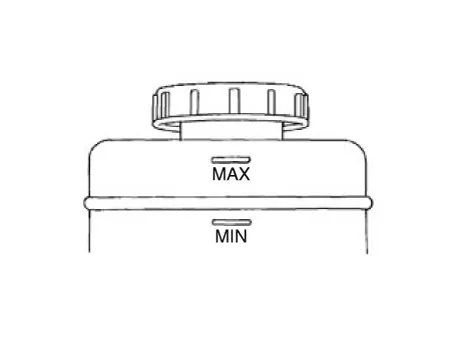
Use only hydraulic brake fluid conforming to DOT 3 or DOT 4 specification.
Check the brake system for any leakage if the fluid level is extremely low (lower than MIN).
Disc Brakes and Pads ➤
Drive Shafts and Boots
Repair procedures
| Inspection |
| 1. |
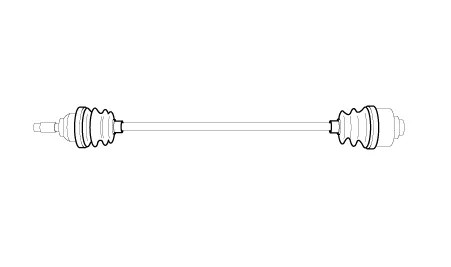
Check the drive shaft boots for loose clamps, cracks, grease leaks, kinks or damage.
|
Parking Brake
Repair procedures
| Inspection |
Check whether the stroke is within specification when the parking brake pedal is depressed with 66 lb, 294 N(30 kg) of force. Also, the parking brake alone should securely hold the vehicle on a fairly steep grade. If the stroke is more or less than specified, have the parking brake adjusted by an authorized Kia dealer.
|
Stroke : 6 - 7 notch |
Steering Gear Rack, Linkage and Boots ➤
Suspension Ball Joints
Repair procedures
| Inspection |
Visually check to be sure that there are no flaws and cracks that may cause injury.
Suspension Mounting Bolts
Repair procedures
| Inspection |
Visually check for loose mounting bolts.
Tire (pressure & tread wear) ➤


Other information:
Kia Stinger (CK) 2018-2023 Service Manual: Automatic transmission operation
The automatic transmission has 8 forward speeds and one reverse speed. The individual speeds are selected automatically, depending on the position of the shift lever. ✽ NOTICE The first few shifts on a new vehicle, if the battery has been disconnected, may be somewhat abrupt. This is a normal condition, and the shifting sequence will adjust after shifts are cycled a few times by the TCM (Transmission Control Module) or PCM (Powertrain Control Module).Description and operation Description Electric E-CVVT system is electric continuous variable valve timing system. It is located on the intake camshaft of the engine and uses motor rotation to control the rotation angle of camshaft relative to the rotation of crankshaft regardless of engine pressure. E-CVVT controls the DC motor current (duty signal) to more closely control the system compared to the previous pressure type, to increase reaction speed of cam, to improve startability, and to reduce the emission of exhaust gas.Categories
- Manuals Home
- Kia Stinger Owners Manual
- Kia Stinger Service Manual
- Brake/Clutch Fluid
- Disc Brakes and Pads
- Drive Shafts and Boots
- Parking Brake
- Steering Gear Rack, Linkage and Boots
- Suspension Ball Joints
- Suspension Mounting Bolts
- Tire (pressure & tread wear)
- New on site
- Most important about car
Contents
