
Kia Stinger CK: Driving your vehicle / Blind-spot Collision Warning (BCW)
Contents:
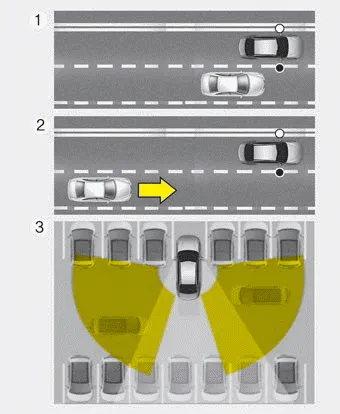
The Blind-Spot Collision Warning (BCW) system uses radar sensors in the rear bumper to monitor and warn the driver of an approaching vehicle in the driver's blind spot area.
The system monitors the rear area of the vehicle and provides information to the driver with an audible alert and a indicator on the outside rearview mirrors.
(1) Blind spot area
The BCW range varies relative to vehicle speed. Note that if your vehicle is traveling much faster than the vehicles around you, the warning will not occur.
(2) Closing at high speed
The BCW-Closing at high speed feature will alert you when it detects a vehicle is approaching in an adjacent lane at a high rate of speed. If the driver activates the turn signal when the system detects an oncoming vehicle, the system sounds an audible alert.
(3) RCCW (Rear Cross-Traffic Collision Warning)
The RCCW feature monitors approaching cross traffic from the left and right side of the vehicle when your vehicle is in reverse. The feature will operate when the vehicle is moving in reverse below about 10 km/h (6 mph). If oncoming cross traffic is detected a warning chime will sound.
WARNING - BCW Limitations
- The Blind-Spot Collision Warning System (BCW) is a supplemental system. Do not solely rely on the system and always pay attention to drive safely.
- The Blind-Spot Collision Warning System may not detect every object alongside the vehicle and is not a substitute for proper and safe lane changing procedures. Always drive safely and use caution when changing lanes.
BCW (Blind-Spot Collision Warning) ➤
RCCW (Rear Cross-Traffic Collision Warning) ➤
Driver's Attention ➤


Other information:
Kia Stinger (CK) 2018-2023 Owner's Manual: Emission Control System
Components and components location Components Location 1. PCV Valve 2. Canister 3. Purge control solenoid valve (PCSV) 4. Fuel tank air filter 5. Catalytic converter (WCC) 6. Vapor hose (Canister ↔ Intake Manifold) 7. Vapor Hose (Canister ↔ Fuel Tank) 8. Ventilation Hose (Canister ↔ Atmosphere) 1.Kia Stinger (CK) 2018-2023 Owner's Manual: Power Door Lock Module
Components and components location Components 1. Door lock/unlock knob cable 2. Door inside handle cable 3. Door latch assembly Repair procedures Inspection • When removing with a flat-tip screwdriver or remover, wrap protective tape around the tools to prevent damage to components.Categories
- Manuals Home
- Kia Stinger Owners Manual
- Kia Stinger Service Manual
- New on site
- Most important about car
Contents
